
印度钢铁运用商协会会长尼库尼·图拉克西亚:美国滥施关税将“自伤”,咱们只需静不雅其变
2025-04-29 15:56:00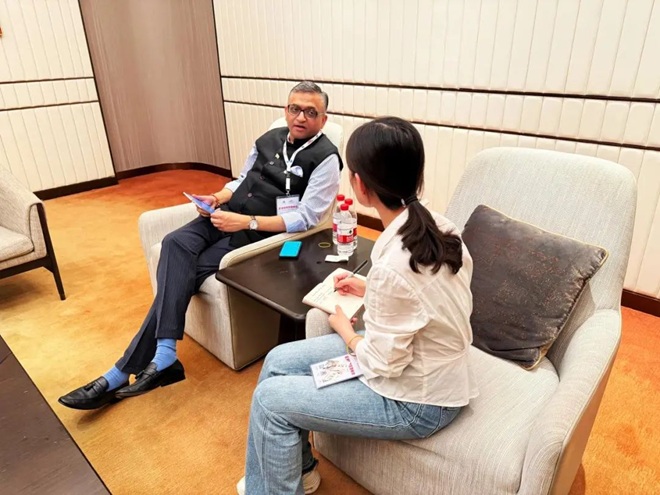 图为尼库尼·图拉克西亚接管《中国冶金报》记者独家专访 (舒礼焕/摄) “美国年夜面积加征关税很是分歧理,这对于美国经济会造成很年夜创伤。从全世界来看,没有任何一个国度可以彻底自力在其他国度,信赖美国终极会心识到这一点并做出调解。”4月21日,印度钢铁运用商协会会长Nikunj Turakhia(尼库尼·图拉克西亚)于接管《中国冶金报》记者独家专访时夸大,“今朝只需静不雅其变,时间会证实许多工具。” “但愿中国钢企深度融入印度的成长” 世界钢协统计数据显示,2024年,中国粗钢产量10.05亿吨,同比降落1.7%;印度粗钢产量1.49亿吨,同比增加6.3%,分列全世界产钢国第1、二位。 尼库尼·图拉克西亚认为,世界第1、第二两年夜国之间开展互助颇有须要,也瓜熟蒂落。“当前,印度钢铁工业成长程度与中国钢铁存于较年夜差距,需要于产物技能、成本勤俭、出产效率等多方面向中国粹习,也但愿中国钢铁企业能深度融入到印度的成长中来。”他说。 据先容,2024-2025财年(2024年4月1日到2025年3月31日),印度GDP总量到达3.89万亿美元,同比增加6.7%,相较在2013-2014财年的1.86万亿美元,已经实现翻番。今朝,印度当局提出5万亿美元GDP成长方针,并经由过程制订数字印度规划、“印度制造”规划等系枚举措,正加快实现这一方针。尤其是于铁路基础举措措施设置装备摆设投资方面,印度2024-2025财年已经经到达320亿美元,相较在2014年(36.1亿美元)增加近8倍。印度经济将来有很好的增加预期。 “但愿中国钢铁企业踊跃介入印度的成长,多开展一些除了钢铁商业之外的互助。”他尤其夸大并建议,“可以于印度设置装备摆设海外仓、建工场、投资高端制造业等,举行更多元的深度互助,也能够将一部门产能转移至印度,这也是规避关税危害的好措施。”他说道。 于他看来,中国钢铁企业当前更可能是“站于门外”举行危害及可行性评估。而日韩与印度签订有自由商业协定,享受着免税准入,是以于印度开展了更多投资。 “欧盟碳关税将来肯定会延期” “虽然印度也举行了一些测验考试,但出产绿钢没有那末轻易,而且征收碳关税将把每一个国度的出产成本进一步增长50美元/吨~100美元/吨,没有任何一个国度真正预备好怎样应答。”尼库尼·图拉克西亚暗示。 国际钱币基金构造(IMF)4月22日发布最新一期《世界经济瞻望陈诉》,将全世界经济增加预期从3.3%年夜幅下调至2.8%,主因是美国单边加征关税激发商业政策不确定性加重。尼库尼·图拉克西亚夸大,当前,全世界经济形势繁杂严重,钢铁行业也面对需求下滑的困境,这一近况其实不会很快改善,经由过程碳关税为行业成长增长难度的做法其实不可取。“欧盟碳关税将来肯定会延期,是以没必要对于此有太多担忧。”他笃定道。 印度当局于2017年5月份发布的扩展钢铁产能的前景计划《国度钢铁政策(2017)》显示,到2030-2031财年,印度规划将粗钢产能扩展至3亿吨。近日,印度钢铁部秘书桑迪普·庞德里克(Sandeep Poundrik)暗示,印度有决定信念告竣3亿吨产能方针,由于估计消费量将快速增加。公然数据显示,印度2021-2023年的钢铁产量增速稳居世界前列。面临快速增加的钢铁产量与低碳转型的压力,印度钢铁财产将怎样均衡? 尼库尼·图拉克西亚直言:“咱们不会决心去做均衡,依然会优先包管出产,满意经济成长需求。”于他看来,欧洲国度于成长期间也举行了年夜量碳排放,但此刻要求其他成长中国度缩减碳排放,这是极其不公允的。同时,于经济繁荣的时辰,“碳”话题被更多地说起,而这两年经济其实不好,国际上评论辩论的强度正于削弱,这是一个动态的历程。 “3亿吨产能规划其实不是底子目的,重要视印度经济成长状态及海内需讨情况而定。”他增补道。—— 英文版 ——Nikunj Turakhia, President of the Steel Users Federation Of India:The US' imposition of tariffs will "hurt itself", and we just need to wait and see. "Large-scale tariff hikes by the United States are highly unreasonable and will cause significant damage to its own economy. From a global perspective, no country can be completely independent of others. I believe the United States will eventually realize this and make adjustments." On April 21, Nikunj Turakhia, president of the Indian Steel Application Association, emphasized in an exclusive interview with China Metallurgical News, "At present, we just need to wait and see. Time will prove many things." "Hope Chinese steel enterprises deeply integrate into India's development" According to the World Steel Association's statistics, in 2024, China's crude steel output was 1.005 billion tons, a year-on-year decrease of 1.7%; India's crude steel output was 149 million tons, a year-on-year increase of 6.3%, ranking first and second globally respectively. Nikunj Turakhia believes that cooperation between the world's top two steel producers is necessary and logical. "Currently, there is a significant gap between India's steel industry development level and that of China. India needs to learn from China in many aspects such as product technology, cost savings, and production efficiency. We also hope that Chinese steel enterprises can deeply integrate into India's development," he said. It is reported that in the fiscal year 2024-2025 (April 1, 2024 to March 31, 2025), India's GDP reached 3.89 trillion US dollars, a year-on-year increase of 6.7%. Compared with 1.86 trillion US dollars in the fiscal year 2013-2014, it has doubled. Currently, the Indian government has set a GDP target of 5 trillion US dollars and is accelerating the realization of this goal through a series of measures such as the Digital India initiative and the "Make in India" program. Especially in terms of railway infrastructure investment, it has reached 32 billion US dollars in the fiscal year 2024-2025, an increase of nearly eight times compared to 3.61 billion US dollars in 2014. India's economy has a good growth outlook in the future. "Hope Chinese steel enterprises participate in India's development and carry out more cooperation beyond steel trade," he emphasized. "It is suggested that they can build overseas warehouses, set up factories, invest in high-end manufacturing, etc., to carry out more diversified and in-depth cooperation. They can also transfer part of their production capacity to India, which is also a good way to avoid tariff risks," he said. In his view, Chinese steel enterprises are currently more "standing outside" to assess risks and feasibility. While Japan and South Korea have signed free trade agreements with India and enjoy duty-free access, they have carried out more investments in India. "The EU carbon tariff will definitely be extended in the future" "Although India has made some attempts, it is not that easy to produce green steel. Moreover, the imposition of carbon tariffs will increase production costs by about 50 to 100 US dollars per ton for every country. No country is truly prepared for how to deal with this." he added. The International Monetary Fund (IMF) released the latest World Economic Outlook report on April 22, significantly lowering the global economic growth forecast from 3.3% to 2.8%, mainly due to the uncertainty in trade policies caused by the unilateral tariffs imposed by the United States. Nikunj Turakhia emphasized that the current global economic situation is complex and severe, and the steel industry is also facing the predicament of declining demand. This situation will not improve quickly, and it is not advisable to increase the difficulty for the industry's development through carbon tariffs. "The EU carbon tariff will definitely be extended in the future, so there is no need to worry too much about it," he said confidently. The Indian government's long-term plan for expanding steel production, the National Steel Policy (2017), released in May 2017, aims to increase crude steel production capacity to 300 million tons by the fiscal year 2030-2031. Recently, Sandeep Poundrik, the secretary of the Indian Ministry of Steel, stated that India is confident of achieving the 300 million tons capacity target because it is expected that consumption will grow rapidly. Public data shows that India's steel production growth rate has been among the world's top in 2021-2023. Facing the rapid growth of steel production and the pressure of low-carbon transformation, how will the Indian steel industry balance these factors? Nikunj Turakhia said straightforwardly, "We will not deliberately try to balance. We will still prioritize production to meet the demands of economic development." In his view, European countries also emitted a large amount of carbon during their development periods, but now asking other developing countries to reduce carbon emissions is extremely unfair. At the same time, the "carbon" topic is more frequently discussed during economic prosperity, but in the past two years when the economy has not been good, the intensity of international discussions has weakened. This is a dynamic process. "The 300 million tons capacity plan is not the ultimate goal. It mainly depends on India's economic development situation and domestic demand," he added.-完美365WM

 137 4451 1124

微信咨询
